Following the demise of Sea Breezes as a magazine in its own right, it is now incorporated into Shipping Today and Yesterday, and David is contributing some articles for the latter.
This is the first…
Readers of the late “Sea Breezes” magazine may be familiar with my “From the brush of David Bray” series of articles. After “SB” ceased publication, said brush became redundant, until your editor, David Sutherland contacted me. So brushes and other equipment have been brought out of retirement.
For those of you not familiar with my work, I am a retired Master Mariner with a keen, lifelong interest in shipping history. Having sailed in traditional liner trades I became very familiar with what constituted an attractive-looking ship. I have painted such vessels in acrylics for many years. Mostly my subjects include liners and cargo vessels from the late 19th/early 20th centuries. Sailing vessels occasionally make an appearance.
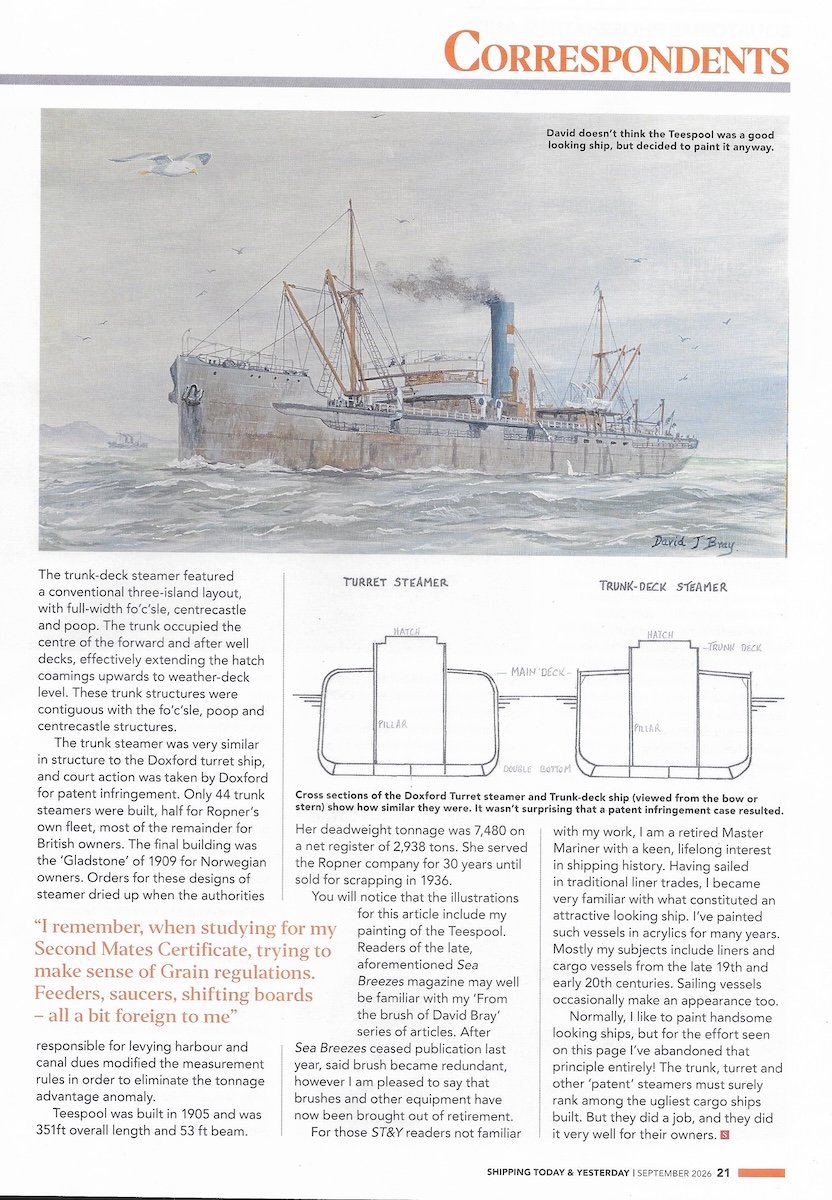
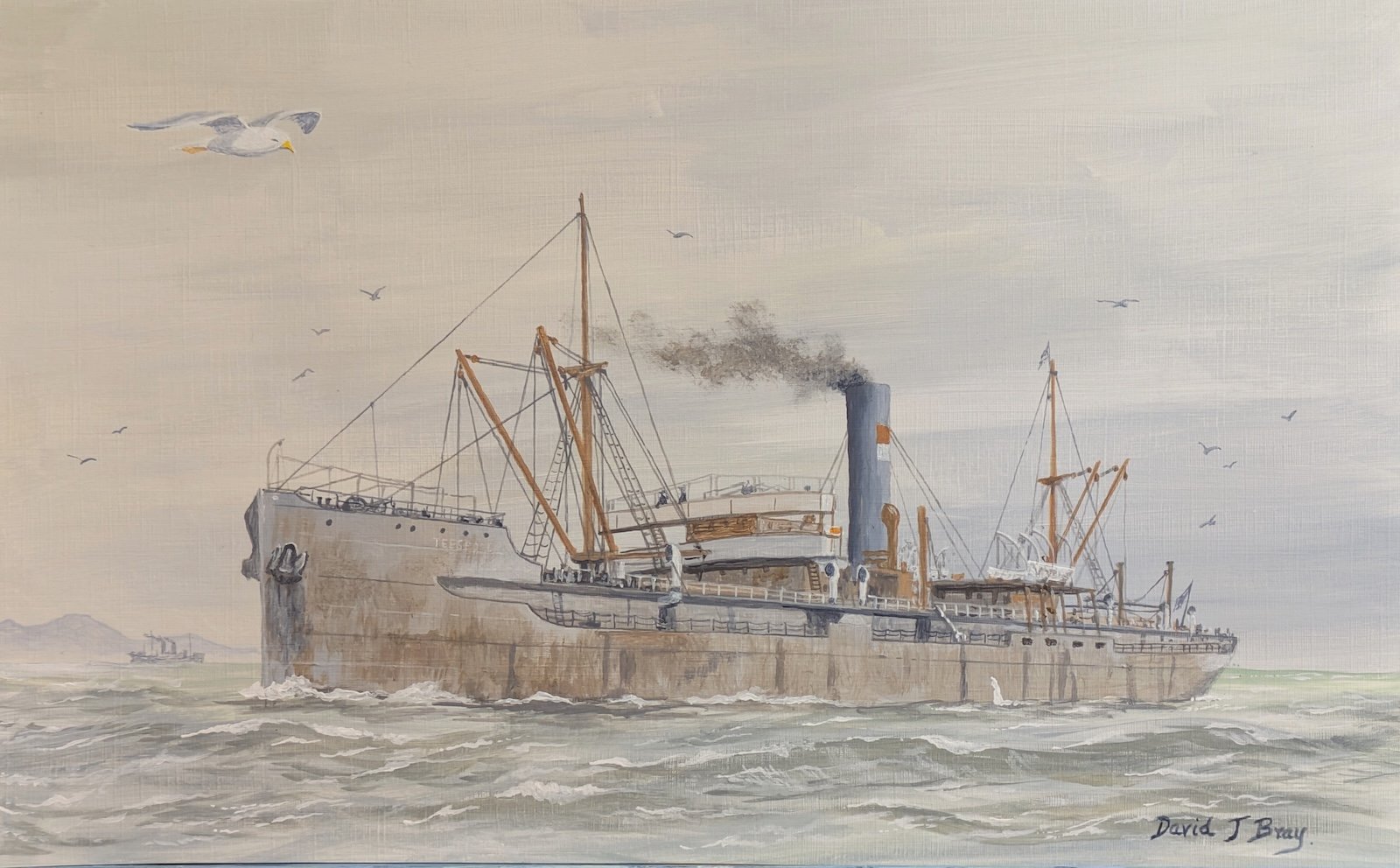
Normally, I like to paint handsome-looking ships. For this effort I’ve abandoned that principle entirely! The trunk, turret and other ‘patent’ steamers must rank among the ugliest cargo ships built. But, they did a job and did it very well for their owners.
Over the years, shipowners operating vessels in the spot market (tramp steamers) have made every effort to reduce costs and maximise income from their hulls. Most cargoes in this sector were homogenous, i.e. a single commodity under the hatches. Typical cargoes include coal, metallic ores and grain. The latter throws up distinct problems.
Grain can be a very fluid cargo, behaving like liquid. After loading, a grain cargo will settle about 5%, leaving a “free surface”. This means that unrestrained, the cargo will shift when the vessel rolls. Thus free surface has a detrimental effect upon the ship’s stability in exactly the same way as free water or oil in a tank.
I well remember, when I was studying for my 2nd Mates’ certificate, trying to make sense of the Grain regulations of the time. Feeders, saucers, shifting boards. All a bit foreign to me, as I sailed in the liner trades, carrying break-bulk cargo. Incidentally, these rules, and much other practical seamanship was taught to me by Captain J H Isherwood, the author of the “Steamers of the Past” series in “Sea Breezes”.
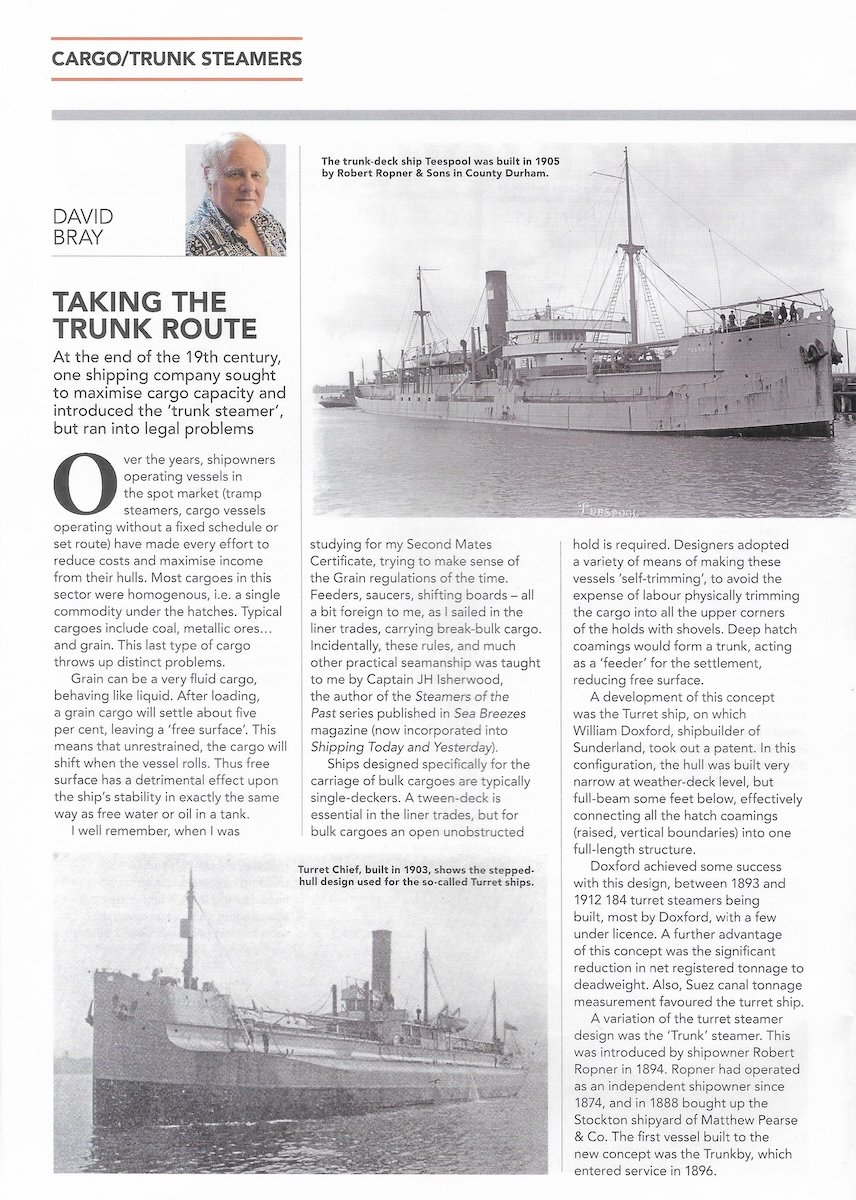
Ships designed specifically for the carriage of bulk cargoes are typically single-deckers. A tween-deck is essential in the liner trades, but for bulk cargoes an open unobstructed hold is required. Designers adopted a variety of means of making these vessels “self-trimming”, to avoid the expense of labour physically trimming the cargo into all the upper corners of the holds with shovers. Deep hatch coamings would form a trunk, acting as a “feeder” for the settlement, reducing free surface. A development of this concept was the Turret ship, on which William Doxford, shipbuilder of Sunderland, took out a patent. In this configuration, the hull was built very narrow at weather-deck level, but full-beam some feet below. Effectively connecting all the hatch coamings into one full-length structure. Doxford achieved some success with this design; between 1893 and 1912, 184 turret steamers were built, most by Doxford, a few under licence.
One further advantage of this concept was the significant reduction in net registered tonnage to deadweight. Also, Suez canal tonnage measurement favoured the turret ship.
A variation of the turret steamer design was the “Trunk” steamer. This was introduced by shipowner Robert Ropner in 1894. Ropner had operated as an independent shipowner since 1874, and in 1888 bought up the Stockton shipyard of Matthew Pearse & Co. The first vessel built to the new concept was the “Trunkby”, entering service in 1896.
The trunk-deck steamer had a conventional three-island layout, with full-width fo’c’sle, centrecastle and poop. The trunk occupied the centre of the forward and after well decks, effectively extending the hatch coamings upwards to weather- deck level. These trunk structures were contiguous with the fo’c’sle, poop and centrecastle structures.
The trunk steamer was very similar in structure to the Doxford turret ship, and court action was taken by Doxford for patent infringement. Only 44 trunk steamers were built, half for Ropners own fleet, most of the remainder for British owners. The final building was the “Gladstone” of 1909 for Norwegian owners. Orders for these designs of steamer dried up when the authorities responsible for levying harbour and canal dues modified the measurement rules to eliminate the tonnage advantage anomaly.
The “Teespool” was built in 1905, and was 351 ft loa and 53 ft beam. Her deadweight tonnage was 7,480 on a net register of 2,938 tons. She served the Ropner company for 30 years until sold for scrapping in 1936.
References:
British Ocean Tramps by P N Thomas, pub. Waine Research Publications 1992
Ropner Trunk-deck steamers. By Harold Appleyard. Article in “Ships in Focus Record” Issue No 2, vol 1. Clarkson publications 1996
Tramp Ships by Roy Fenton. Seaforth publishing 2013