From the brush of David Bray
This article, and others, follow a series which Sea Breezes magazine is publishing, featuring David’s paintings, and the stories behind them.
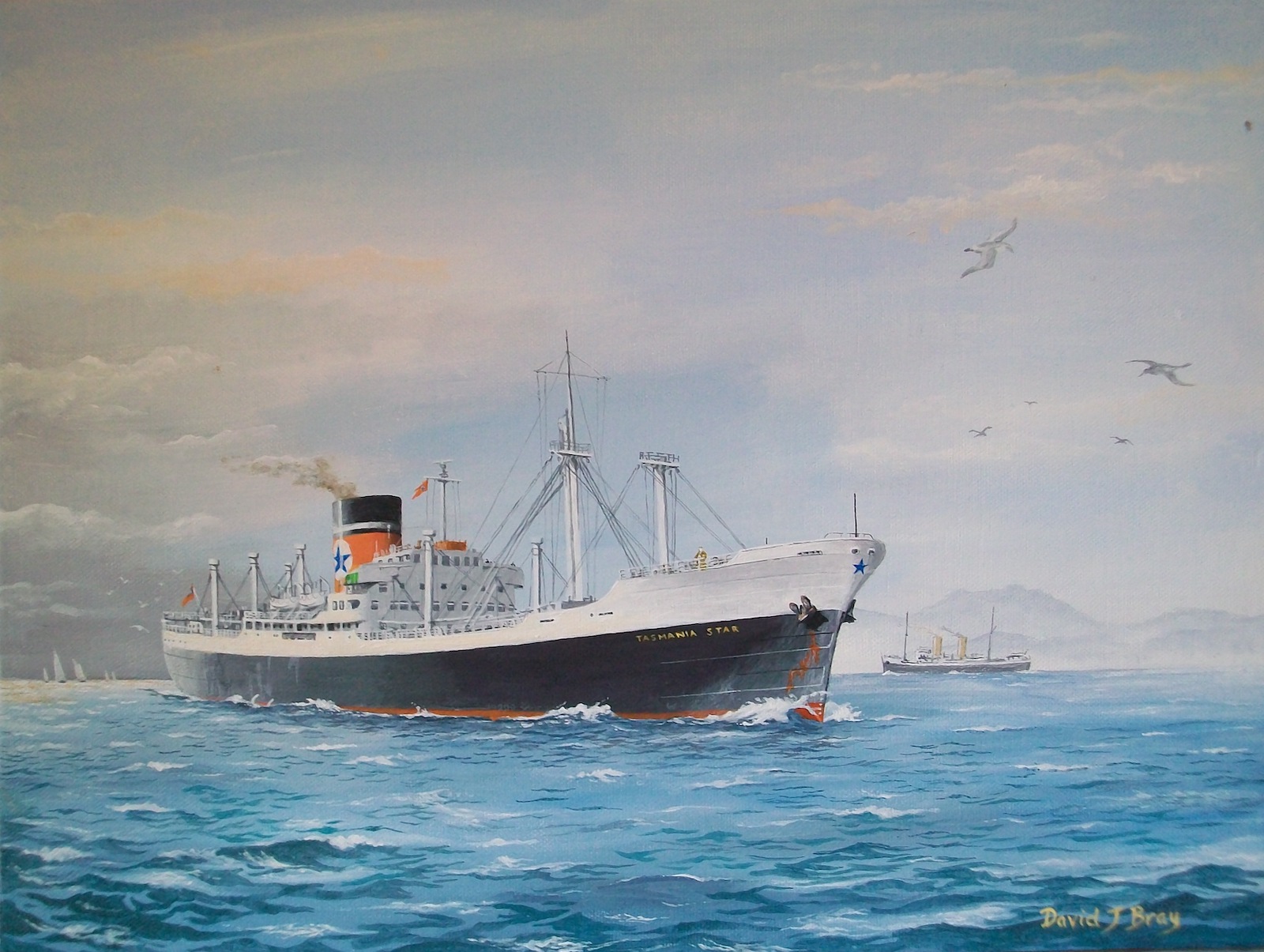
This month’s painting is one I completed some time ago at the request of Gerolf Drebes. He and I were sailing as passengers on the cruise ship “Discovery” in 2009, on one of Des Cox’s “Maritime Memories” jaunts. Gerolf had seen some of my paintings and asked me if I could paint “Tasmania Star”; a ship in which he had sailed as engineer.
The reason I am having to revert to a picture from the past is that my kitchen studio/shipyard is currently out of action. A water leak has led to rooms being stripped out for drying. Chaos reigns just now in the Bray abode! But worse things happen at sea, as they say.
“Tasmania Star” was one of four close-sisterships built for Blue Star, three entering service in 1950 and the final member of the class , the “Auckland Star” appearing in 1958. Delivered from Cammell Laird, Birkenhead in October 1950, “Tasmania Star” was one of the large fleet of refrigerated cargo ships serving the Vestey meat empire. Of 11,950 tons gross and 572 ft loa, she was of conventional cargo-ship profile, with seven hatches served by 22 derricks plus one 60-ton jumbo derrick, on two masts forward and eight sampson posts. Just over half of her 960,000 cu ft capacity was refrigerated. Her cargo spaces consisted of seven holds with two or three tweendecks. She was powered by steam turbines of 16,000 shp, reduction geared to a single shaft giving her 16 knots. It seems that she traded continuously on the Blue Star services to Australia and New Zealand, occasionally South Africa. When built they were the largest refrigerated ships in the world.
Her three sisters were “Auckland Star”, “Adelaide Star” and “Wellington Star” although both of the latter were motorships, powered by opposed-piston Doxfords. All three served under their original names for Blue Star until 1975. The earlier two were disposed for scrap in this year, but “Wellington Star” was sold and renamed “Hawkes Bay”. Converted to a livestock carrier, she eventually went for scrap in 1979. The final member of the class; “Auckland Star” was laid up in the Blackwater river in 1977 and was scrapped the following year.
Blue Star line was formed in 1911 to serve the foodstuff business of William and Edmund Vestey. Prior to this the brothers had developed a food importation and brokerage business in the Liverpool area from the 1880s. Establishing the Union Cold Storage Co Ltd in 1897 the firm benefitted from the new technology allowing refrigerated meat and dairy products to be carried internationally by ship. The first two vessels purchased were the “Rangatira” and “Paheka”, bought from Shaw, Savill in 1909. Further ships were acquired and given names prefixed “Brod…” e. g. “Brodstone” and “Brodmore”. At this time most meat trade was with South America. Despite the loss of five ships during the First World War, the fleet grew rapidly, and in 1919 became the Blue Star Line, with the familiar funnel colours, and “Star” names. For a number of years the naming scheme was conjoined such as “Trojanstar”, “Normanstar” etc.
The business expanded into Australia and New Zealand in the early 1920s, and the high -street butcher chain of Dewhurst was established. The company expanded hugely during this period, purchasing and importing huge quantities of meat from Australia, New Zealand, Argentina and Uruguay. In 1926 four passenger liners were built for the South American trade with a fifth the following year. The company was little affected by the great depression of 1930, and was able to order new tonnage for the Australian and New Zealand services, also entering the South African trade. The parent company Union Cold Storage bought outright or shares in many meat packing and supply firms worldwide.
Between 1935 and 1940 ten large, fast refrigerated motorships were built for the Australasian trades. Similar ships were built for the other conference members; Shaw, Savill and the New Zealand Shipping Co. These were known as the “Empire Food Ships” and became valuable assets during World War 2. During that conflict 29 of the fleet of 38 ships were lost to enemy action, probably the greatest proportion of any shipowner. Five of the Empire Food Ships supported the supply of Malta during 1941/42.
When I was cadet in Ellerman’s, we were always amused that Blue Star ships didn’t carry radar. When I attended my Radar Observer Course in 1968 one course attendee was a Blue Star cadet. He was quite put out that the company had sent him on a radar training course when very few of their ships were radar-fitted. In 1944 the “Australia Star” which was equipped with a rudimentary radar, had what must have been the first “radar-assisted collision” with the Panamanian steamer “Hindoo” during zig-zagging in convoy. Blue Star refused to fit radar until well into the 1970s.
Post-war, Blue Star rapidly rebuilt the fleet with modern design tonnage, helping to ease the UK meat rationing which lasted until 1954. For the South American trade four passenger ships were built in 1947; the “Argentina”, “Brazil”, “Uruguay” and ” Paraguay ” Stars. I was Third mate on the “City of Capetown” in King George V dock London in 1969 when the “Paraguay Star” in the berth opposite was destroyed by fire. A sobering experience and a sad end to a fine ship.
One additional specialisation of Blue Star was the carriage of heavy lifts. Whilst many general cargo vessels sported a jumbo derrick of 40-70 tons, the “South Africa Star” was equipped with a 180 ton derrick on the foremast. This vessel had been built in 1943 as the auxiliary aircraft carrier USS “Winjah”. Allocated to the Royal Navy in 1944 she became HMS “Reaper”. After the war’s end she was bought by Blue Star and rebuilt as the “South Africa Star”. The American auxiliary carrier design was based on the hull and machinery layout of the American standard “C3” cargo ship. “South Africa Star” proved so successful at handling very lucrative heavy lifts that further ships were so equipped. The largest capacity was that of the “Australia Star” of 1965, which had a 300 ton Stülcken derrick.
The glory days of the company were the 1960s. Despite extensive diversification, and an initially successful foray into containerisation (ACT) the writing was on the wall for traditional refrigerated cargo vessels. The final Blue Star was the “Canterbury Star”, one of four built by Harland and Wolff in 1986. In 1998 Blue Star Line container business was taken over by P&O Nedlloyd, while reefer ships were operated jointly with Hamburg Sud until 2001.